03 June 2010

Hoodwinking

Is the UK about to star in a remake of Japan - the Lost Decade? That is the question behind a recent talk by Adam Posen, one of the team that sets interest rates at the Bank of England.

Professor Posen is an expert on the Japanese experience, so his views are worth hearing. He adds to the fun by peppering his talk with references to films by Japanese director Akira Kurosawa. Kurosawa's films, such as The Seven Samurai, have led to Hollywood remakes. Most recently one of my favourites, Rashomon was turned into a children's film, Hoodwinked (hence the frog).

After Japan's property bubble burst at the start of the 90s, the country fell into a deflationary trap. For the next decade its economy refused to recover. Could we be in for the same fate?

Prof Posen argues that Japan's continuing malaise was caused by policy mistakes. At several points the economy did pick up only to fall flat due to mistakes by policymakers. Economic growth did not flat-line; it saw-toothed. The key mistakes were withdrawing stimulus too soon and not forcing the banks to recognise bad loans and clean up their balance sheets. It was also too slow to try unconventional monetary policy once interest rates had reached zero.

In Britain and in Europe we have avoided that last mistake; but I worry about the other two. Have we done enough to fix the banks? Certainly across Europe more needs to be done - the Spanish Cajas and the German Lanesbanken need to face up to the loans they made which will never be repaid. Banks also need to take a realistic view of the sovereign debt they hold, and raise their capital accordingly. Will Greek bonds really be repaid at 100 centimes to the Euro?

On stimulus, I've already had my say - reduce the deficit over the medium term but not yet.

Deflation is too little understood concludes the good professor as he calls for more research. Inflation is a danger we know and can deal with, deflation is still mysterious. If we have to balance risk then risking inflation is the better choice.

31 May 2010

1937 Again, Again

It is not just fiscal policy which is heading in the wrong direction, influential voices now want monetary policy to retreat from supporting the economy. The OECD wants the UK to start raising interest rates this year and to as much as 3.5% by the end of next year.
Why?
Interest rates are lifted to reduce inflation, so where does the OECD think inflation is going?
Inflation is high, but is projected to fall below the 2% target, once the temporary effects of the increase in the VAT rate wane, due to significant economic slack.
No inflation, but raise rates anyway, just in case? I think not.

27 May 2010

Oh My Gawd, They Killed Recovery!

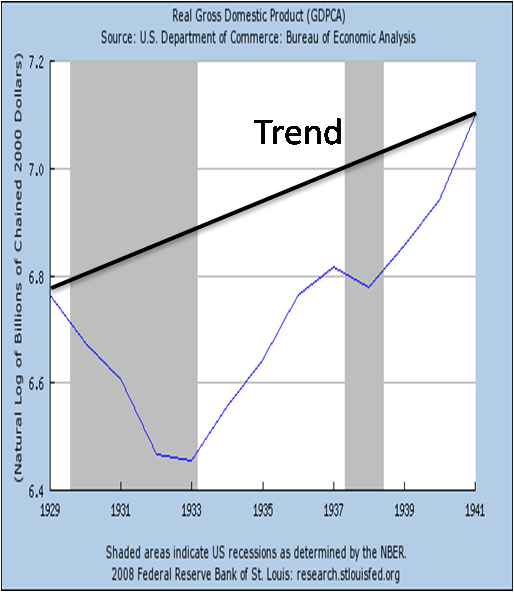
Not yet, perhaps but 2010 is beginning to look like 1937.

In 1937, Roosevelt cut government spending in the belief that the Great Depression was over. The result was a new recession and the Depression went on.

This week, Italy has announced cuts of €24 billion targeting pensions, public sector wages and recruitment. Spain is cutting €15 billion with public sector pay again in the firing line. Portugal announced its austerity measures back in March. Even Germany is preparing cuts - apparently to set an example for the others.

One difference between Europe today and the US in 1937 is that the Fed tightened monetary policy while European interest rates are unchanged. That is a little deceptive since interest rates are at their lower bound. It is difficult to loosen monetary policy when interest rates are almost at zero, otherwise monetary policy would be looser.

Back in January, Paul Krugman was warning of the danger that the US might replay 1937.

26 May 2010

A Bigger Cut

On Monday the government took bold action to cut the deficit by annoucing £6.2 billion of cuts to public expenditure in this financial year. 


The previous Friday, The Office of National Statistics cut the deficit by £7.4 billion.

The Office for National Statistics (ONS) has revised down the amount borrowed by the government last year from £163.4bn to £156bn.

17 May 2010

Euro-Brady Bonds


There is one aspect I don't get about the €110 billion Greek bailout (which is big enough to save Greece the bother of going to the bond market for a few years).
Why have the Eurozone countries agreed to lend money to Greece before it defaults? Would it not be better to have the default (or rescheduling if you prefer) first and then offer guarantees for new borrowing?
That would work a bit like the Brady bonds issued following the Latin American defaults in the 80s. The US guaranteed the Bradies which were backed by debtor country assets and IMF receipts.

See Wikipedia for more on Bradies.