30 March 2012

Here Comes the Judge

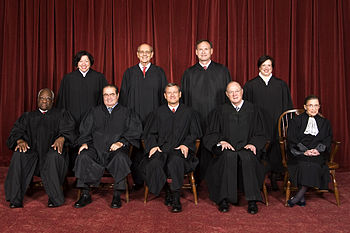
Courts, no matter how Supreme, are not known for thier ability to handle scientific evidence. The economics behind Obamacare, or the Affordable Care Act, ought to be at the heart of the case currently before the US supreme court. It isn't. The Administration is not arguing the economics, perhaps anticpating that the Justices would not understand. They might be right.

ACA require everyone to buy health insurance. Otherwise something called adverse selection kicks in - only those likely to get sick buy insurance making it prohibitively expensive for those who remain. Justice Scalia doesn't get it:

You could say that about buying a car. If -- if people don't buy cars, the price that those who do buy cars pay will have to be higher. So you could say in order to bring the price down, you are hurting these other people by not buying a car. (See here page 19 line 10)
Anyone who has opened an economics text book can answer that one. If some people don't buy cars then the demand for cars falls.  The price falls not rises. (The demand schedule moves down and intersects the supply schedule at a lower point giving a lower equilibrium price.)

You might want to argue about whether supply curves really slope upward the way they do in textbooks but that is beside the point. The issue is that insurance is not like a textbook competitive market and the comparison with cars or broccoli is irrelevant. Adverse selection is a market failure and governments need to intervene to correct it.

16 March 2012

Lord, Won't You Buy Me a Mercedes-Benz

With the budget coming up next week I've been preparing the evidence to rebut the Chancellor's porkies. His main theme for some years has been that government debt caused the crisis. (I suppose  he hopes that we will forget about the housing boom, sub-prime mortgages, collateralised debt obligations, shadow banking and the general belief that risk had been magicked out of the financial markets.)

I came across some figures for debt in 2008 in an interesting report.* UK government (gross) debt was 52% of GDP, household debt was 101% and firms outside the financial sector had debt of 114% of GDP. I've put the figures on a chart with a few other countries for comparison.


If debt was the problem then was it government who was running it up?

12 March 2012

Blowing Bubbles (After They've Burst)

The government has a new plan to reinflate the housing bubble. It's a complex scheme involving 95% mortgages, participation by the building industry and a public sector guarantee.

The problem with the scheme is that house prices are still too high. The Nationwide index of house prices to earnings (based on first time buyers) shows that currently house prices are 4.4 times earnings. The chart below is based on their data. I have fitted a trendline on the data from 1983 to 2003 (that is the two decades before the bubble). It shows that house prices fluctuated around 2.9 times earnings.

House prices are likely to fall, or at best stagnate for a long period. Of course lower property prices could depress household demand. Is it responsible policy to keep house prices inflated?

Lower prices would do more to help first time buyers. Building  houses should help to stimulate growth in the economy and make housing more affordable.

06 February 2012

Neville for Chancellor

Brad DeLong, the Berkeley economist, has a nice piece on how Neville Chamberlain was right.

Britain recovered from the great depression faster than the US, and faster than we are recovering from the current depression. DeLong gives credit to Chancellor of the Exchequer Chamberlain who ignored the orthodox calls for austerity and implemented a policy of fiscal stimulus. Unlike his successor today:
The failure of expansionary austerity in Britain should give all of its advocates around the world reason to reflect on and rethink their policy calculations.
...if expansionary austerity is not working in Britain, how well can it possibly work in countries that are less open, that can’t use the exchange-rate channel to boost exports, and that lack the long-term confidence that investors and businesses have in Britain?
You don't need to be a Keynesian to get it right.

31 January 2012

The Wrong Treaty

So the summit succeeded in agreeing a new EU treaty. I have one question. Of the 27 European leaders in the room was there not one who proposed to change the treaty to allow the ECB to buy government bonds directly from their treasuries?

Mr Draghi constantly points out that it is the Lisbon treaty which prevents the ECB acting as lender of last resort. Not only might removing this obstacle have been a reasonable quid pro quo for the restriction on fiscal freedom, it would deal directly with the crisis unlike the treaty agreed which will do nothing to ease the Euro's problems.