31 May 2010

1937 Again, Again

It is not just fiscal policy which is heading in the wrong direction, influential voices now want monetary policy to retreat from supporting the economy. The OECD wants the UK to start raising interest rates this year and to as much as 3.5% by the end of next year.
Why?
Interest rates are lifted to reduce inflation, so where does the OECD think inflation is going?
Inflation is high, but is projected to fall below the 2% target, once the temporary effects of the increase in the VAT rate wane, due to significant economic slack.
No inflation, but raise rates anyway, just in case? I think not.

27 May 2010

Oh My Gawd, They Killed Recovery!

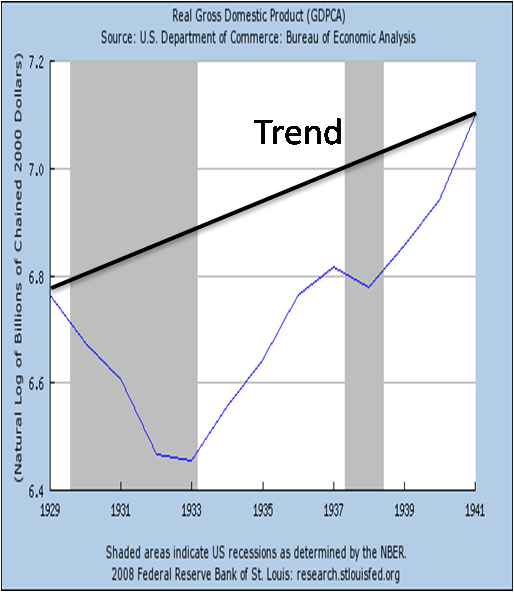
Not yet, perhaps but 2010 is beginning to look like 1937.

In 1937, Roosevelt cut government spending in the belief that the Great Depression was over. The result was a new recession and the Depression went on.

This week, Italy has announced cuts of €24 billion targeting pensions, public sector wages and recruitment. Spain is cutting €15 billion with public sector pay again in the firing line. Portugal announced its austerity measures back in March. Even Germany is preparing cuts - apparently to set an example for the others.

One difference between Europe today and the US in 1937 is that the Fed tightened monetary policy while European interest rates are unchanged. That is a little deceptive since interest rates are at their lower bound. It is difficult to loosen monetary policy when interest rates are almost at zero, otherwise monetary policy would be looser.

Back in January, Paul Krugman was warning of the danger that the US might replay 1937.

26 May 2010

A Bigger Cut

On Monday the government took bold action to cut the deficit by annoucing £6.2 billion of cuts to public expenditure in this financial year. 


The previous Friday, The Office of National Statistics cut the deficit by £7.4 billion.

The Office for National Statistics (ONS) has revised down the amount borrowed by the government last year from £163.4bn to £156bn.

17 May 2010

Euro-Brady Bonds


There is one aspect I don't get about the €110 billion Greek bailout (which is big enough to save Greece the bother of going to the bond market for a few years).
Why have the Eurozone countries agreed to lend money to Greece before it defaults? Would it not be better to have the default (or rescheduling if you prefer) first and then offer guarantees for new borrowing?
That would work a bit like the Brady bonds issued following the Latin American defaults in the 80s. The US guaranteed the Bradies which were backed by debtor country assets and IMF receipts.

See Wikipedia for more on Bradies.

14 April 2010

Agency Capitalism

When Karl Marx defined capitalism he meant an economic and a social system in which power rested with the owners of capital. In today's capitalism the owners have been usurped by a new class of executives.
The idea that a firm might be run for the benefit of its managers rather than the owners is not new. Economist refer to this as the "agency problem". In theory, the shareholders own the firm and appoint a board of directors to ensure that the firm is run well and profitably. Yet over time the professionals running the company manage to divert the company's resources to their own benefit - a more comfortable office, a car and driver, a company plane, a bigger salary, a performance bonus and share options.

My contention is that the agency problem has grown to such a stage that it now defines the nature of the economy. The outlandish levels of remunerations which bankers and executives in the financial sector award themselves is only the most blatant example of the new agency capitalism. In some cases, as much as half a firm's net earnings are paid out as bonuses. The obvious questions are: how has this happened and what is the alternative?

In the 19th century the owners of capital were largely wealthy individuals. They could take an interest in the firms in which they invested to ensure that they continued to develop and grow and provide a good return. Now individual shareholders are a small part (10%) of the stock exchange. In 2008, 42% of shares in the London stock market were held overseas. Of the remainder 40% are owned by financial institutions - insurance companies, pension funds, mutual funds etc. (Details here) So two-thirds of UK shares held in the UK are owned, not by top hatted capitalists, but by us - people who pay into occupational pension funds, private pension funds, insurance policies and ISAs.

Strictly speaking they are owned by the insurance companies, pension funds and other institutions; but it is our money they are investing ultimately for our benefit.

With 42% of shares owned overseas and 40% owned by institutions, the company owners are no check on the executives running the companies. It is no wonder bankers can get away with daylight robbery.

The problem is compounded by the idea that a company's purpose is to provide "shareholder value"; an idea which has reduced the shareholder's interest to whether the share price is going up.

What is the alternative? I believe that there is an alternative to agency capitalism. More on that another day.